From February 12 to July 19, 2026, Pirelli HangarBicocca will present Rebecca, the first solo exhibition by Benni Bosetto in a museum. Conceived as an environment to be inhabited, the works transform the museum into a domestic and imaginative space, where lightness, rest, and pleasure take on a critical dimension. The exhibition unfolds as a "sensorial manifesto" reflecting on some of the most urgent tensions of the present—between freedom and control, self-determination and constraint, productivity and desire—affirming daydreaming as a form of resistance.
"The exhibition is an invitation to reclaim public and museum spaces as places to dream. Daydreaming becomes a collective exercise in imagining a desirable future based not on productivity, but on sensitivity, emotion, and transformation", explains Benni Bosetto.
Benni Bosetto (born in Merate in 1987; currently lives and works in Milan) explores the human experience and questions of identity through drawing, sculpture, installation, and performance, focusing on the physicality of bodies. Her work builds an intimate, layered imaginary world in which individuals, organisms, and animal species coexist and contaminate one another. Understood as an active tool for relating to the world, the body is central to Bosetto's practice. Desire, sexuality, presence, and vulnerability emerge as fields of inquiry, cultivating what the artist defines as a "form of resistance" to the ways the body is conventionally conceived. Bosetto manipulates, edits, and layers sources ranging from literature and anthropology to popular culture, cinema, psychoanalysis, and art to create surreal, dreamlike representations. Through the construction of hyper-narratives, the artist shapes a potentially infinite poetic discourse in which each piece emerges from the convergence of multiple origins and imaginaries. During the initial phase of her creative process, she collects visual, textual, autobiographical, and iconographic materials in an almost compulsive manner. These materials are then layered and transformed to generate new images. Fascinated by the codes of staging and their transformative potential, she creates mutable environments that give rise to an immersive experience for viewers, where different temporal dimensions and perspectives intertwine and coexist.
Bosetto earned a degree in painting and a postgraduate specialization in sculpture from the Brera Academy of Fine Arts, and expanded her international experience by studying at the Universität der Künste in Berlin. She first approached artistic expression through classical dance. Since childhood, ballet has instilled in her an exactness in her movements and an awareness of her body as an expressive tool. Bosetto is a distinctive voice of her generation because of her radical use of drawing as an expanded practice and her view of art as a total experience that blends gesture, matter, and ritual while remaining deeply rooted in the manual and physical nature of artistic creation through sculpture and performance. Her relevance in the contemporary Italian art scene stems from her ability to blend her own interpretation of the present with an open dialogue with artists and imagery from recent art history. Her work reveals affinities with the unsettling sensuality of Louise Bourgeois, the ritual physicality of Ana Mendieta, the material instability of Eva Hesse, the visionary freedom of Carol Rama, and the poetic and performative tension of Rebecca Horn. Within this resonance, Bosetto develops a language in which the body is both living matter and a symbolic device, an unstable threshold between surface and depth. Rejecting any conceptual fixedness, her work embraces an experiential, intimate, and spiritual dimension in which lightness becomes a political and emotional act—a process of unveiling where drawing, sculpture, and space converge into a unified sensory narrative.
Curated by Fiammetta Griccioli, Rebecca is the Italian artist's first major institutional exhibition. The title is inspired by the 1938 novel of the same name by English writer and playwright Daphne du Maurier (1907–1989). In the novel, the real protagonist is a house that preserves the memory of a deceased woman named Rebecca, who lived there. The house in the novel, just like the display at Pirelli HangarBicocca, becomes a true architectural female body, a living organism. The name Rebecca, whose etymology refers to "bond" or "union", alludes to welcoming, gathering, and retaining – acts that are central to Bosetto's poetics of merging the body and environment in an intimate, continuous relationship.
The exhibition project transforms the Shed space by evoking a domestic and welcoming environment, where rooms, walls, and surfaces seem to come alive, giving the space a private and inhabited dimension. It is both a place and a statement: at an historical moment when everything is dominated by production speed, Bosetto invites us to reclaim our subjective time, a time for dreaming, resting, and regaining our imagination. The exhibition becomes at once an intimate place and a political act. Visitors are welcomed into a dreamlike landscape where every element evokes the desire to imagine, and where erotic and pleasure-related signs form the backdrop to a refuge in which everyone can rediscover themselves, free from social conditioning. Another key element of Bosetto's artistic practice is the physical creation of her work through long hours of manual labor. Each drawing is created by hand by the artist over the course of several months. Every ornament, every decoration devoid of functional purpose within the domestic space, takes on symbolic value. Ultimately, her entire artistic practice aims to achieve one outcome: providing shelter from the urgency and pressure of linear time. Here, visitors can daydream and have the freedom to imagine and affirm their present and future.
At the entrance La Bocca (the mouth, 2022), which consists of iridescent, scaly fabric with a large, circular eye applied to it, guides visitors into the exhibition. Le Cellule (the cells, 2026), is made of hundreds of strips of hand-drawn wallpaper by Bosetto and will cover the perimeter of the entire exhibition space. This installation will transform the museum's architecture into a living surface. As the artist explains, it is "a physical and repetitive gesture that connects the space to the body, making it tactile and sensitive". The walls will be covered with drawings of the tangible traces left by bodies and gestures, intertwining with plant figures that are sometimes aphrodisiac, invasive, resilient, tranquilizing, or intoxicating.
The monumental intervention is divided into three distinct, interconnected rooms, each named after different parts of the body: the cheek, the belly, and the heart. Inside, works created specifically for the exhibition will be displayed alongside past installations and performances that explore memory and ritual, love and care, constraint and freedom—concepts that resonate in both the individual and collective bodies. The right aisle, titled "la guancia" (the cheek), will evoke a soft, inviting environment and explore a reflection on decoration and ornamentation and on their ability to establish an emotional relationship with inhabited spaces. This aligns with the ideas of British writer William Morris (1834–1896) who conceived ornament as an ethical and social necessity: for Morris, decor arises from conscious craftsmanship, from the harmony between form, function, and material, inseparable from the quality of everyday life. Central to this section is the work that gives it its name: La guancia (2026). It is conceived as a space dedicated to rest, contemplation, and "daydreaming" as a collective gesture. Deck chairs, rugs, and suspended sculptures will breathe life into this environment, offering the public an opportunity to experience the passage of time more slowly and transform imagination into active thinking aimed at building a future based on sensitivity and emotion.
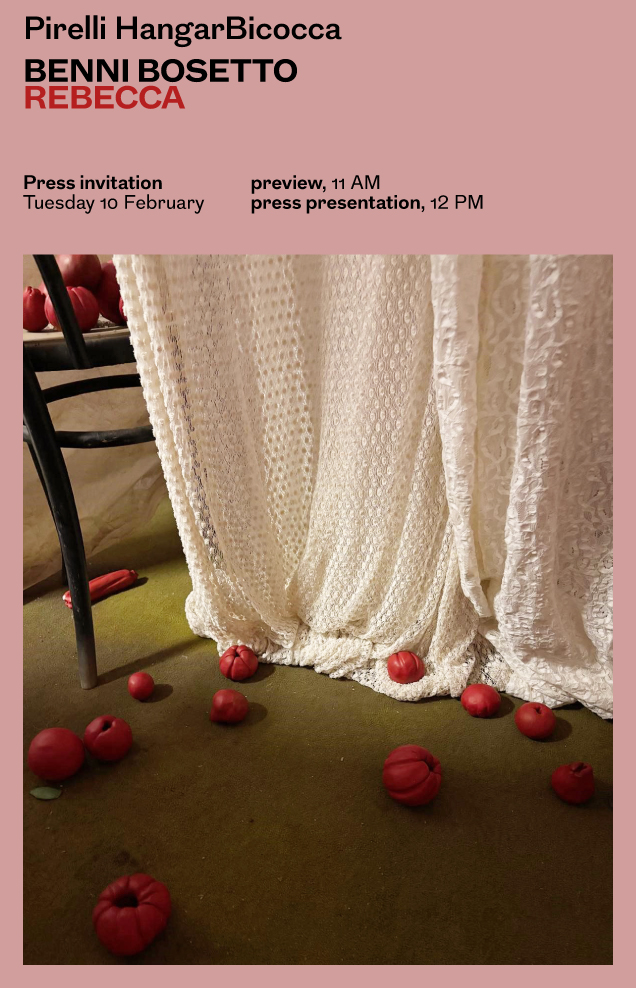
The central nave will host "la pancia" (the belly), a space designed for metamorphosis and transformation, connected to instinct and impulse. The new series Le porte (the doors, 2026), on display here, includes nine works created specifically for this exhibition and arranged horizontally on the floor as "horizontal doors", containers that hold artworks, characters, and environments recreated by Bosetto. These works explore the architectural element of the door, a symbolic archetype of the home, that traditionally embodies authority, and exclusion. Here, this function is overturned and the door becomes a device of hospitality through material, narrative, and poetic work. Inspired by cinematic and psychological languages, the works become places to inhabit rather than merely thresholds to pass through. Each contains objects, traces, collected materials, organisms, and archives, functioning more like a narrative micro-environment. As the artist says, "The horizontal door loses its conventional function. Rather than separating spaces, it blurs them. It is an overturned threshold—a passive yet protective door at rest. When inclined, the door loses its position as a passageway and becomes closer to the idea of fall or containment". The space will also include Gli occhi (the eyes, 2026), the "guardians" of the house: two rolled-up lace curtains from which two pairs of terracotta shoes poke out. The shoes evoke the presence of hidden female figures and refer to the childhood game of hide-and-seek. However, their excessive size gives the furnishings a human appearance, making them anthropomorphic.
Finally, the left aisle will represent "il cuore" (the heart), the beating nucleus of the exhibition. This room is dedicated to emotional impulses such as love, and infatuation. Inside, visitors will experience the performance and installation Tango (II Version) (2023–2026). This piece reflects on the process of falling in love as a kind of intoxication and the physicality of feelings, while playing with clichés and archetypes associated with love. Inspired by tango and the traditional milonga setting, the performance will be repeated regularly throughout the exhibition at Pirelli HangarBicocca. Sessions will feature amateur dancers wearing headdresses that resemble animals and plants, creating an interspecies choreography. As the artist describes, tango is an "antidote to loneliness," a language of connection, and a meeting place of different identities and natures. This concept echoes post-human and queer thinking in its exploration of identity metamorphosis and the porous boundaries between species and matter. Small tables with chairs will be placed on either side of the milonga, with the masks displayed on them as stage props, allowing the domestic space—typically reserved for intimate and private moments—to open up to the possibility of creating a community.
The artist
Some of the institutions and independent spaces that have hosted solo exhibitions by Benni Bosetto include the following: Museo della Marineria Washington Patrignani, Pesaro; Spazio Lima, Milan (2024); Villa di Geggiano, Emanuela Campoli, Siena; MAMbo - Museo d'Arte Moderna di Bologna (2022); Almanac Inn, Turin (2020); Kunstraum, London (2019); Fonderia Battaglia, Milan (2018); Convento de los Domenicos, Eivissa, Spain (2017); Tile Project Space, Milan (2016).
Her work and performances have been presented in various group exhibitions, including: Madre - Museo d'Arte Contemporanea Donnaregina, Naples; Castello di Rivoli Museo d'Arte Contemporanea, Rivoli-Turin (2024); MAXXI - Museo Nazionale delle Arti del XXI Secolo, Rome (2023); GAMeC - Galleria d'Arte Moderna e Contemporanea di Bergamo, Bergamo (2022); MART - Museo d'Arte Moderna e Contemporanea di Trento e Rovereto, Trento (2021); Quadriennale d'Arte, Rome (2020); Fondazione Sandretto Re Rebaudengo, Guarene (2020); Villa Medici, Rome (2019); OGR - Officine Grandi Riparazioni, Turin (2018); MAMbo - Museo d'Arte Moderna di Bologna (2018); Baruchello Foundation, Rome (2018); FutureDome, Milan (2017).
Catalogue
To coincide with the exhibition, Marsilio Arte will publish a monographic catalog devoted to Benni Bosetto. The book will explore recurring themes in the artist's research and feature an essay by curator Milovan Farronato that delves into the theoretical references and imagery in the artist's work. It will also feature a text by curator Caterina Molteni that focuses on Bosetto's artistic evolution from her beginnings to the present. A selection of Bosetto's images, drawings, and archival materials will accompany thematic contributions by international scholars and critics focusing on the displayed works. These include texts by art historian Chus Martínez, curator Marianna Vecellio, writer Giulia Civardi, and curator Evelyn Simons. A conversation between curator Fiammetta Griccioli and the artist will present the Pirelli HangarBicocca exhibition project, enhanced by extensive photographic documentation.
Pirelli HangarBicocca
Pirelli HangarBicocca is a non-profit foundation dedicated to producing and promoting contemporary art. It was conceived and is supported by Pirelli. Established in 2004, Pirelli HangarBicocca has become a benchmark institution for the international art community, local public and region. It is a museum that is free of charge, accessible and open, and a place for experimentation, research and dissemination, where art is a point of reflection on the most topical themes of contemporary culture and society.
It caters to a broad and diverse public with a programme of major solo exhibitions by both Italian and international artists, a multi-disciplinary program of accompanying events and in-depth discussions, theoretical and informational publications, and educational courses. A team of museum facilitators is on hand at all times to help the public connect with the art.
Vicente Todolí has been the foundation's artistic director since 2012.
Situated in a former industrial building, once a locomotive manufacturing facility, Pirelli HangarBicocca occupies 15,000 square metres, making it one of the largest single-level exhibition spaces in Europe. This vast area comprises the Shed and Navate spaces, which are used for temporary exhibitions, and the permanent display of Anselm Kiefer's The Seven Heavenly Palaces 2004-2015. This monumental installation with seven reinforced concrete towers has become one of the most iconic works in Milan. While since 2010 La Sequenza (1971-1981), a work by sculptor Fausto Melotti, has been located in the outdoor garden at the entrance of Pirelli HangarBicocca.
The building also houses a number of services for the public: a spacious entrance with reception area, facilities for educational activities, space for conferences and meetings, bookshop and bistro with a charming outdoor area.



Commenti
Posta un commento