From September 17, 2026, to January 17, 2027, Pirelli HangarBicocca presents "XYZ," Aki Sasamoto's first solo exhibition at a European institution, bringing together more than two decades of interdisciplinary experimentation, where science and intuition, mathematics and emotion, absurdity and seriousness, the everyday and the extraordinary coexist. Through sculptures, installations, and performative activities, Sasamoto engages with themes related to human and social relationships, memory, and emotional experience, offering a unique journey that bridges rigor and profound humanity.
“The world I touch and the world I understand via language are so different. The world only makes sense somewhere between what I make and what I end up doing with it,” explains Aki Sasamoto.
Aki Sasamoto (born in Kanagawa, Japan in 1980; currently lives and works in New York) operates at the intersection of performance, sculpture, installation, and video. She creates environments and situations in which people and objects interact, exploring the relationship between body and space to engage audiences on multiple sensory levels. Drawing from diverse disciplines such as dance, mathematics, social psychology, meteorology, and eco-behavioral sciences, her works—hybrid in both form and content—translate lived experiences and personal narratives into metaphorical imagery, evoking liminal moments and new narratives, suspended between logic and intuition. Through unconventional interactions with everyday objects—often manipulating and distorting them—Sasamoto stages a tragicomic spectacle that challenges traditional modes of perception, and rewrite the possibilities and limitations of sculptural and performative language. Thus, the artist’s works become a grounding of the reality that surrounds her. As she herself explains, “My work deals with the problems of life, not art”, and in doing so, it redefines a subjective perspective on the world that appears at once familiar and universal.
After leaving Japan to study in Wales and later in the United States, Sasamoto initially pursued mathematics before earning a Bachelor’s degree in dance at Wesleyan University in Middletown, Connecticut, and subsequently an MFA in Visual Arts from Columbia University’s School of the Arts in New York. This experience of geographical and cultural displacement informs her work, which addresses psychological dimensions, the complexity of emotions and habits, interpersonal relationships, and the tensions that emerge in communication processes. Having approached art through dance and theatrical performance, Sasamoto became fascinated by the improvisational nature of jazz, and developed an early interest in the sonic and gestural experiments of the 1950s and 1960s. Among her key references are composers such as John Cage (1912–1992), David Tudor (1926–1996), and, above all, Alvin Lucier (1931–2021).
The exhibition “XYZ,” curated by Roberta Tenconi with Tatiana Palenzona, marks the first institutional exhibition dedicated to the Japanese artist in Europe. The title immediately suggests the exhibition's layered nature, as it presents a selection of works spanning two decades of Sasamoto's practice. “XYZ” carries multiple meanings: as the final letters of the alphabet, when placed at the end of a list, they suggest possible continuations beyond an apparent ending; in the Cartesian system, they indicate the coordinates that define the three dimensions of space; in quantum physics, they designate variables used to describe the probability of a particle occupying a given point; finally, they are also the acronym for "eXamine Your Zipper," a common American expression discreetly used to indicate an open zipper.
Conceived by Sasamoto specifically for Pirelli HangarBicocca, the exhibition unfolds as a dynamic sequence of installations, sculptures, videos, and performances that explore ideas of connection, the complexity of relationships, and the influence of societal norms and interpersonal interactions on the body and memory. Spanning over twenty years of interdisciplinary experimentation, the show project emphasizes the artist’s ability to reconcile seemingly opposing elements—performance and sculpture, science and intuition, absurdity and discipline—in works that are simultaneously playful, rigorous, and deeply humane. References to mathematics recur throughout the exhibition path in the form of graphs, diagrams, lines, and rotating mechanisms that connect the works, bringing together material and immaterial dimensions and creating a constant tension between measurable data and emotional experience. As Sasamoto explains, “The diagrams are reflectors of the discomfort in life––an attempt to get to the heart of it. I want to take emotion seriously, but emotion is hard to take as it is. Diagrams appear more light-hearted and distant than speaking in serious language with a straight face. I prefer facing the board, drawing, with my back to the world.” While each work maintain its autonomy, the show creates connections between projects from different moments of Sasamoto’s career, forming an evolving system of meanings that invites the audience to reflect on the present and on the possible trajectories of contemporary life.
Upon entering the Shed, visitors encounter Sounding Lines (2024), a kinetic installation composed of springs suspended in space and oversized fishing lures incorporating kitchen utensils. Activated by programmed motors, the springs oscillate, evoking the movement of waves and, more subtly, the unstable and fluctuating rhythms of human relationships and friendships. Fishing, food and cooking—recurring motifs in Sasamoto’s work that are rooted in everyday life—emerge here as ambivalent metaphors. This imagery reappears in catch or be caught (2025), a sculpture consisting of two metal structures that move vertically in an alternating sequence, opening and closing in a motion that oscillates between the form of a traditional crab trap and the organic shape of a stylized flower. The resulting mechanical choreography suggests a reflection on the physical tension and vulnerability of space.
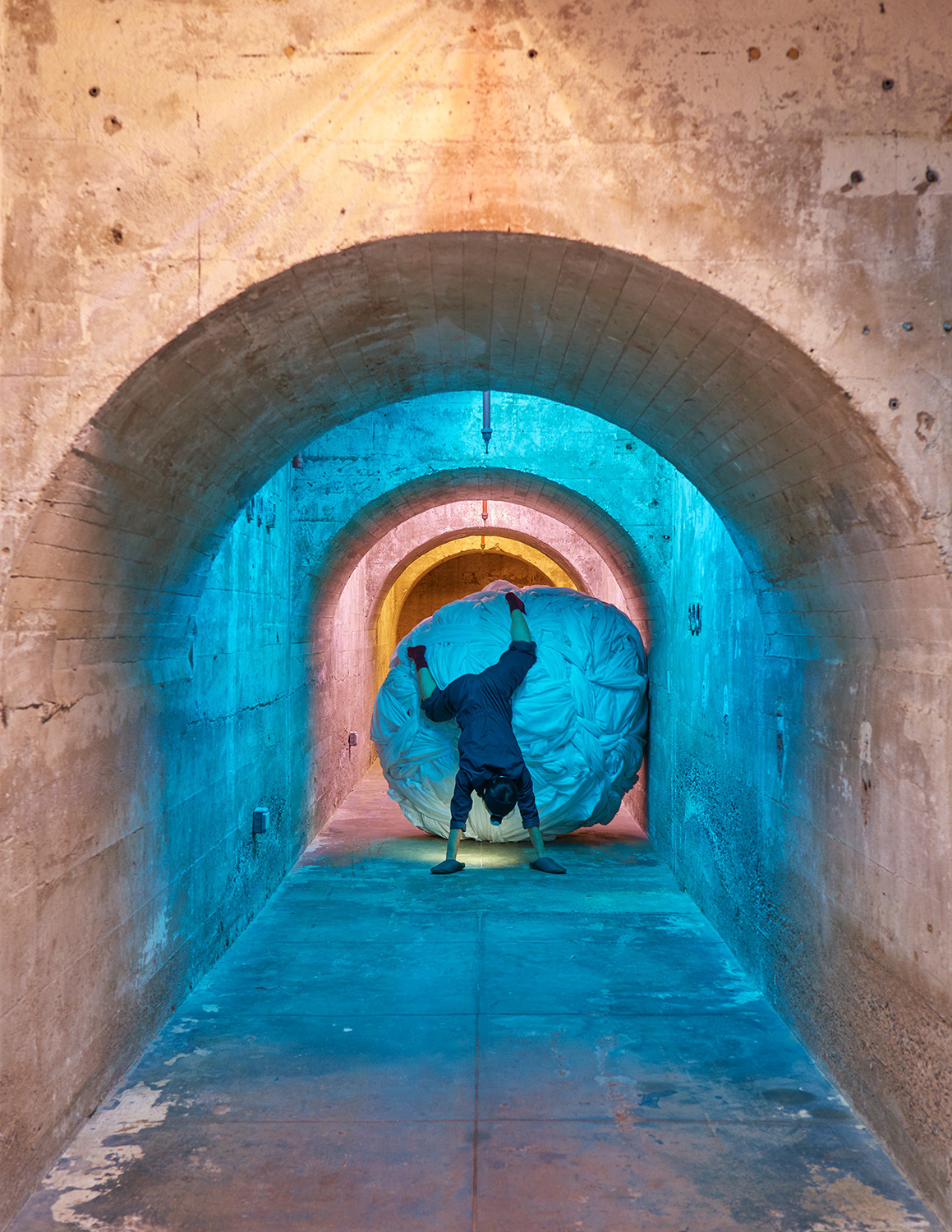
Continuing along the exhibition path, Delicate Cycle (2016) explores the idea of non-linear time and challenges the very notion of cyclical processes. Through the presence of washing machines and references to the dung beetle—a creature that has fascinated the artist since childhood—circular movement becomes the underlying motif running throughout the exhibition. In the performance, Sasamoto activates the work by rolling a large sphere wrapped in bedsheets: this gesture prompts reflection on feelings of anxiety surrounding order and control, extending the logic of washing to the mechanisms of memory and to the illusion that a stain can ever be permanently erased.
Many of Sasamoto’s works originate from personal life experiences, as in the installation and performance Secrets of My Mother’s Child (2009), which addresses the subject of intergenerational trauma. Furniture and everyday objects evoke the domestic sphere while simultaneously suggesting the emotional structures of family life through an architectural framework. Through an exploration of the dynamics and tensions shaping her relationship with her mother, the work opens onto a broader reflection on the nature of secrecy. As she puts it, "that transition from secret to revealed fact is fascinating to me." This tension between proximity and distance, as well as between knowledge and mystery, materializes in the sculptural presence of a suspended metal bar shaped after the mathematical function X x Y = 1, the curve whose two asymptotic lines approach one another without ever touching. Thus, the image becomes a metaphor for the secret itself: something one aspires to know; yet, once revealed, it inevitably ceases to be a secret.
The use of everyday materials also emerges in Centrifugal March (2012), in which Sasamoto incorporates modified furniture, such as wardrobes and beds, to reflect on centrifugal forces. Here she also adds ice, an unstable and ever-changing material, introducing a temporal and sonic dimension to the work. As the ice slowly melts, it produces a subtle sound amplified by hidden microphones that marks the passage of time and accompanies the metamorphosis of matter, while simultaneously evoking themes of memory and rituals of body preservation after death. Originally conceived for the Whitney Biennial, Strange Attractors (2010) unfolds as a constellation of suspended elements—including tables, closed-circuit cameras, drinking glasses nestled within fruit nets—composing an environment of altered and reconfigured household objects. In mathematics and chaos theory, a "strange attractor" describes a dynamic structure in which multiple elements coexist, generating a system where order emerges within apparent disorder.
The exhibition also features Wrong Happy Hour (2014), an installation that transforms the space into a dysfunctional bar. From inside the Shed gallery, the environment is only visible from the rear, while a complete view of the interior is possible from outside the building through a glass door. During the performance, the installation functions as an actual bar, where visitors can drink and linger, while Sasamoto moves amongst the objects posing questions to the audience. Eventually, the performance culminates in the artist physically pushing visitors out by moving the back wall forward, turning the environment from a relational space into a place that progressively narrows until exclusion. Alongside the installation, the eponymous video revisits the narrative of the artist’s monologue performed live in the space. The motif of the bar also returns in Past in a future tense (2019), an equally dysfunctional social setting in which elements are connected through the movements of air. Whisky glasses move inside hand-blown Murano glass spheres placed on three small tables and a counter, activated solely by air currents. The installation is complemented by the videos entitled Weather Bar Forecast #1 and Weather Bar Forecast #2 (both 2021), which adopt the format of television weather forecasts, emphasizing the dissonance between their measured, factual language and the increasingly unstable and alarming reality of climate catastrophe.
Cooking Show (2005), presented at Pirelli HangarBicocca through video documentation, dates back to an early stage of Sasamoto’s practice, when her work was rooted in theatre and explored the boundaries between performance and live spectacle. Seeking to deconstruct the surreal aesthetics and eccentric logic of television cooking programs, the artist performs conventional culinary procedures using disproportionately sized utensils, altering familiar processes and introducing unexpected information. The deliberately exaggerated scale of the objects transforms them into tools through which the difficulties inherent in interpersonal communication can be articulated, rendering everyday actions both comically impractical and visually dissonant.
The artist
Aki Sasamoto has had solo exhibitions at: MOT Museum of Contemporary Art Tokyo (2025); Para Site, Hong Kong (2024); Queens Museum, New York (2023); American Academy of Arts and Letters, New York (2023); Danspace Project, New York (2020); The Kitchen, New York (2017); SculptureCenter, New York (2016); Para Site, Hong Kong (2016); Center for Curatorial Studies, Bard College, New York (2012).
Sasamoto has also participated in numerous international group exhibitions at institutions such as National Museum of Modern and Contemporary Art, Seoul (2024); San Jose Museum of Art (2024); Verge Center for the Arts, Sacramento, California (2024); Mori Art Museum, Tokyo (2023); Herzliya Museum of Contemporary Art, Tel Aviv (2023); Museum of Contemporary Art Busan, South Korea (2022); Kunsthal, Rotterdam (2021); Hirosaki Museum of Contemporary Art, Aomori, Japan (2021); Power Station of Art, Shanghai (2016); High Line Art, New York (2014); Mori Art Museum, Tokyo (2013).
Additionally, the artist’s works and performances have been presented at numerous biennials, including the 59. Venice Biennale (2022); Aichi Triennale (2022); Busan Biennale (2022); Okayama Art Summit (2022); Kochi-Muziris Biennale (2016); the Whitney Biennial, Greater New York (2010); and the Yokohama Triennale (2008).
In 2023, the artist received the Calder Prize, and completed a residency at Atelier Calder in Saché, France in 2021. Aki Sasamoto is Professor and Director of Graduate Studies in Sculpture at Yale University's School of Art.



Commenti
Posta un commento